1. An Overview of the Endocrine System
Communication within the human body involves the transmission of signals to control and coordinate actions in an effort to maintain homeostasis. There are two major organ systems responsible for providing these communication pathways: the nervous system and the endocrine system.
The nervous system is primarily responsible for rapid communication throughout the body. As discussed in previous chapters, the nervous system utilizes two types of signals – electrical and chemical (Table 17.1). Electrical signals are sent via the generation and propagation of action potentials which move along the membrane of a cell. Once the action potential reaches the synaptic terminal, the electrical signal is converted to a chemical signal as neurotransmitters are released into the synaptic cleft. When the neurotransmitters binds with receptors on the receiving (post-synaptic) cell, a new electrical signal is generated and quickly continues on to its destination. In this way, neural communication enables body functions that involve quick, brief actions, such as movement, sensation, and cognition.
In contrast, the endocrine system relies on only a single method of communication: chemical signaling (Table 17.1). Hormones are the chemicals released by endocrine cells that regulate other cells in the body. Hormones are transported primarily via the bloodstream throughout the body, where they bind to receptors on target cells, triggering a response. Because of this dependence on the cardiovascular system for transport, this type of communication is much slower than that observed for neural signaling. As such, hormonal communication is usually associated with activities that go on for relatively long periods of time.
In general, the nervous system involves quick responses to rapid changes in the external environment, and the endocrine system is usually slower acting—taking care of the internal environment of the body, maintaining homeostasis, and controlling reproduction. This does not mean, however, that the two systems are completely independent of one another. Take for example the release of adrenaline from the adrenal medulla as part of the ‘fight-or-flight’ response. Although adrenaline uses blood for transportation throughout the body, the effects are evident within seconds after the event has occurred; how does the response happen so quickly if hormones are usually slower acting? It occurs so rapidly because the nervous and endocrine system are both involved in the process: it is the fast action of the nervous system responding to the danger in the environment that stimulates the adrenal glands to quickly secrete their hormones. In such a situation, the nervous system causes a rapid endocrine response to deal with sudden changes in both the external and internal environments when necessary.
| Endocrine and Nervous Systems (Table 17.1) | ||
|---|---|---|
| Endocrine system | Nervous system | |
| Signaling mechanism(s) | Chemical | Chemical/electrical |
| Primary chemical signal | Hormones | Neurotransmitters |
| Distance traveled | Long or short | Always short |
| Response time | Fast or slow | Always fast |
| Environment targeted | Internal | Internal and external |
Endocrine Organs
Hormones are released by secretory cells that are derived from epithelial tissue. Often, these cells are clustered together, forming endocrine glands. Unlike exocrine glands, which have a duct for conveying secretions to the outside of the body (e.g., sweat gland), endocrine glands secrete substances directly into the surrounding interstitial fluid. From there, hormones then enter the bloodstream for distribution throughout the body.
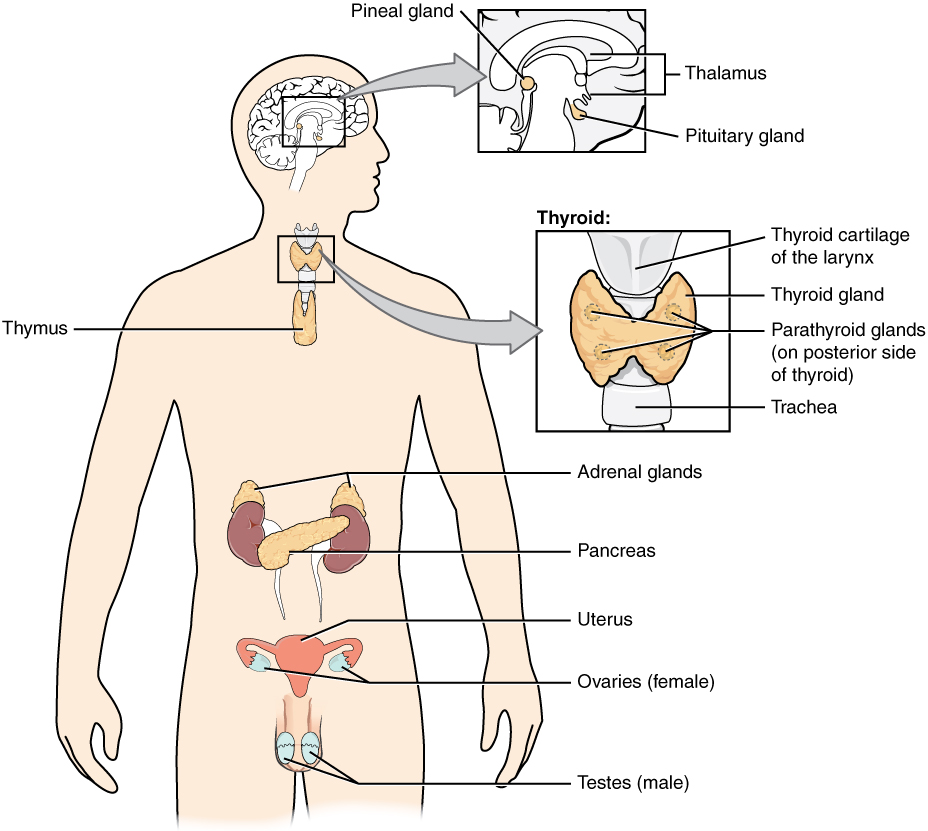
The major endocrine glands found in the human body include the pituitary gland, thyroid gland, parathyroid glands, thymus gland, adrenal glands, pineal gland, testes, and ovaries (Figure 1.1). While some of the glands are pure endocrine (e.g., thyroid gland), others serve both endocrine and exocrine function. For example, the pancreas contains cells that secrete digestive enzymes and juices into the small intestine (exocrine function) and cells that secrete the hormones insulin and glucagon, which regulate blood glucose levels.
In addition to the endocrine glands, major organs of the body show endocrine function including the hypothalamus, heart, kidneys, stomach, small intestine, and liver. Moreover, adipose tissue has long been known to produce hormones, and recent research has revealed a role for bone tissue in hormone production and secretion.
Other Types of Chemical Signals
In the classical definition of the endocrine system, hormones are secreted into the interstitial fluid and then diffuse into the blood or lymph for circulation throughout the body to reach target tissues. However, in certain instances, target cells are local and do not require hormones to enter the blood. If a chemical signal is released into the interstitial fluid and targets neighboring cells, then the activity is referred to as paracrine. Neurotransmitter communication between a pre- and post-synaptic neuron is a good example of paracrine activity. Alternatively, chemicals released by a cell elicit a response in the same cell that secreted it, demonstrating autocrine activity. An example of this is type of activity is Interleukin-1, signaling molecule released in an inflammatory response that binds to receptors located on the surface of the cell releasing the molecule.